Core 110f
Q-SYS network + analog I/O processor (v2)
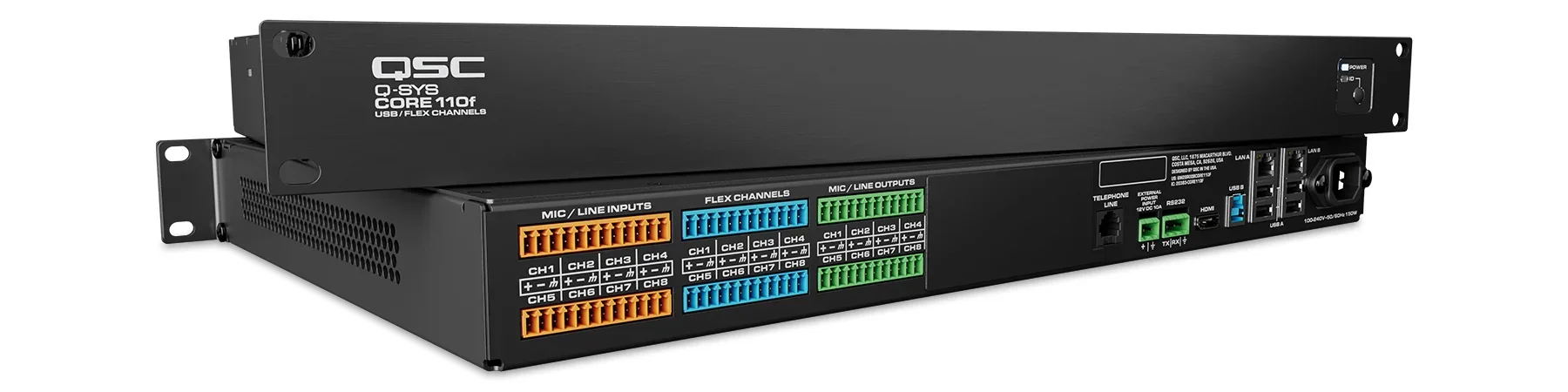
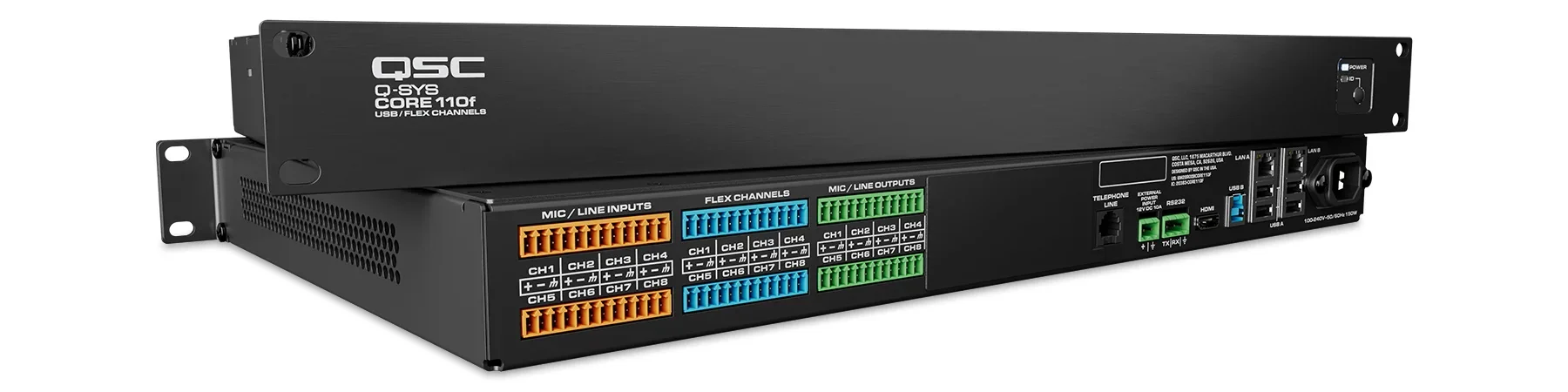
The Q-SYS™ Core 110f v2 processor provides a fully integrated audio, video and control solution for installations with a mixture of analog and network channels, supporting medium-sized rooms through the largest Enterprise scale deployments.

Features & Benefits
128 x 128 total network I/O channels
64 x 64 total network I/O streams
24 channels of analog I/O, including 8 configurable Flex channels
16x AEC processors
Supports up to 4x Q-SYS NM-T1 network microphones
Up to 32 x 32 Dante audio channels (8 x 8 included)
USB AV bridging (16 x 16 audio + Q-SYS camera support)
Full-featured Q-SYS Control engine (with optional feature license)
External USB audio device host
Up to 4x VoIP instances
Class leading I/O: Core 110f has 24 I/O + USB, POTS and VoIP simultaneously offering the best cost to I/O ratio in a single SKU, single chassis product available on the market.
8 Flex Channels: Nearly all the flexibility of a card-based DSP solution without the hassle of multiple SKU’s and custom ordering.
Extend your network I/O connectivity with QIO Series: QIO Series lets you quickly add network I/O connectivity to your Q-SYS systems where it’s most convenient. Each of the six models supports a different, specific connectivity type, from mic/line audio I/O to control (IR, Serial, or GPIO).
True IT Software Integration: The Q-SYS Operating System is a true IT integrative solution that is free of the fixed hardware limitations seen in competing products. It allows for greater functionality such as Layer 3 routing, LDAP contact server integration, SNMP monitoring, as well as the latest software-based security for your AV system like cryptographically signed firmware updates, encrypted data transport and storage.
Suite of Software-Based Conferencing Technology applications: Built by Q-SYS from the ground up allowing for continued refinement, without any additional hardware. The suite includes next generation acoustic echo cancellation (AEC), multiple-instance SIP softphones, gain sharing, gating automixers and role-based access controls.
Unified Software Platform: The integrator has a single training investment in one software design tool rather than needing to learn several platforms to scale from small to large systems.
Technical Specifications
-
Model: Core 110f
Input Frequency Response
20Hz to 20kHz @ +21dBu: +0.05dB/-0.5dB
Input THD+N @ 1KHz
@ +21 dBu Sensitivity & +21 dBu input: < 0.1%
@ +21 dBu Sensitivity & +10 dBu input: < 0.0015%
@ +10 dBu Sensitivity & +8 dBu input: < 0.0007%
@ -10 dBu Sensitivity & -10.5 dBu input: < 0.0006%
@ -39 dBu Sensitivity & -39.5 dBu input: < 0.007%
EIN (no weighting, 20Hz to 20kHz): < -121dB
Input to Input Crosstalk @1kHz: >110dB Typical, 90dB Max
Input Dynamic Range
@ +21 dBu Sensitivity: > 109.5dB
@ +10 dBu Sensitivity: > 106.4dB
@ -10 dBu Sensitivity: > 104.6dB
@ -39 dBu Sensitivity: > 104.6dB
Input Common Mode Noise Rejection
@ +21 dBu Sensitivity: Not specified
@ +10 dBu Sensitivity: 56.5
@ -10 dBu Sensitivity: 73.2
@ -39 dBu Sensitivity: 63.2
Output Level Range (1dB Steps): -39 dBu min to +21 dBu max
USB B
Bit Depth: 16-bit
Number of Channels: Up to 16 × 16
Sample Rate: 48kHz
Environmental
Power Consumption: 60 watts, typical. 120 watts max
BTU/Heat load: 205 BTU/Hour
General
Compliance: FCC Part 15B (USA), FCC Part 68 / TIA-968-B (USA), JATE (Japan), AS/ACIF S002 (Australia), PTC200 (New Zealand), ES203 021 (Europe), ANATEL Resolution 473 (Brazil), NOM-151-SCTI (Mexico), PSTN01 (Taiwan), Industry Canada CS-03 (Canada), CE marked (Europe), UL and C-UL listed (USA & Canada), RCM (Australia), EAC (Eurasian Customs Union) & RoHS Directive (Europe)